

Energy Advisor: Kurdistan Central to Emerging Trade Corridors
Reports 03:34 PM - 2026-07-04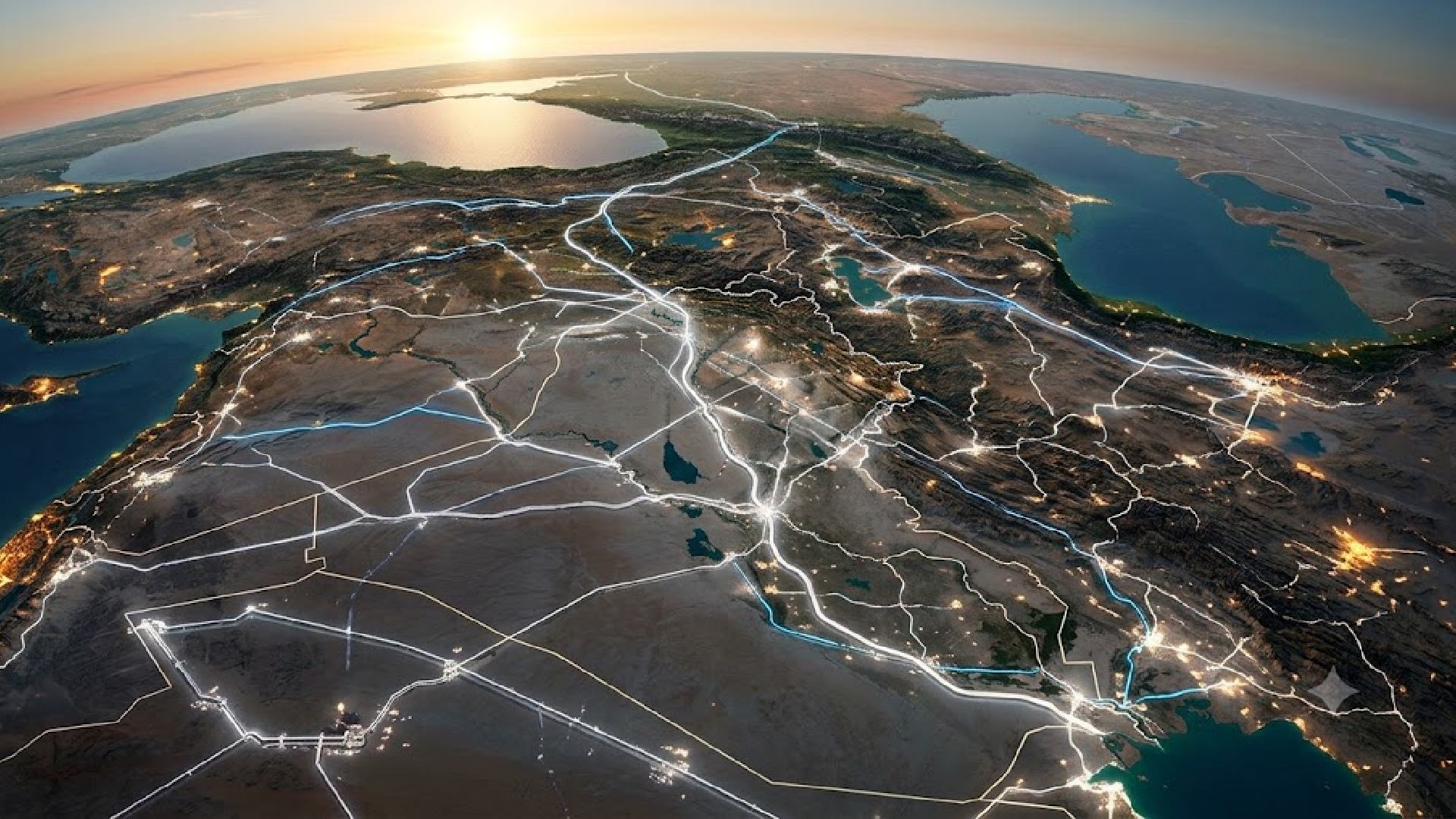 AI generated photo
A map of the Middle East.
A legal and energy advisor has said the world is currently experiencing an “economic Cold War”, in which global and regional powers are competing for control over strategic trade and energy corridors, reshaping the geopolitical map, adding that Kurdistan is at the heart of this equation because of its geographical location.
Rebwar Mohammed Amin, Legal and Energy Advisor, told PUKMEDIA that the United States, China, the European Union, and regional actors including Iran, Türkiye, and Gulf states are all competing over the control of transport routes for goods and energy.
He said that historically, major conflicts have not only been fought over territory but also over the control of trade routes. In the 21st century, he argued, this has evolved into a “war of corridors”, driven by major infrastructure and connectivity projects such as China’s Belt and Road Initiative, the U.S.-backed India–Middle East–Europe Corridor (IMEC), and Iraq-Türkiye’s Development Road.
He added that the Middle East—and Kurdistan in particular—sits at the centre of this emerging strategic framework, making regional stability a decisive factor in the viability of such projects.
According to him, the emerging global order is based on the integration of economic and security considerations, and is shaped by three main competing corridors:
- The Chinese Belt and Road Initiative, aimed at linking Asia to Europe via Iran, Iraq, Syria, or Türkiye.
- The India–Middle East–Europe Corridor (IMEC), running from India through the UAE and Saudi Arabia to Europe, which he said is designed in part to counterbalance Chinese and Iranian influence.
- The Iraq–Türkiye Development Road, a regional project intended to connect Iraq’s Grand Faw Port to Türkiye and onward to Europe.
Amin stated that Kurdistan lies at the heart of these dynamics due to its strategic geographical position. He said Southern and Western Kurdistan lie along key routes of the Development Road and Iranian access corridors towards the Mediterranean, while instability in these areas could disrupt the functioning of any proposed transit networks. He also noted that Northern and Eastern Kurdistan serve as a bridge between Central Asia, Iran, and Türkiye, and that the region’s oil and gas reserves play an important role in supplying energy to these corridors.
He further described Iran and Kurdistan as “shock-bearing” regions within the broader geopolitical system for these reasons:
- Competing interests: Iran seeks to maintain its regional sphere of influence along the Tehran–Baghdad–Damascus axis, while the United States and its allies aim to challenge and bypass this corridor. Kurdistan, he said, lies strategically between these competing blocs.
- Political instability: The absence of a unified and independent Kurdish political entity, he argued, has turned the region into a theatre for proxy competition.
- Pressure from neighbouring states: Türkiye and Iran, he said, are using major economic development initiatives as instruments of influence, including efforts to exclude Kurdish areas from key infrastructure projects such as proposed railway routes linked to the Development Road.
In terms of solutions, he called for the establishment of a Kurdish High Strategic Council and a joint research and decision-making body among all parts of Kurdistan to monitor geopolitical developments.
He also stressed the need for strengthening domestic infrastructure, investing in transport networks and the energy sector—particularly natural gas—to position Kurdistan as an attractive economic hub linked to European markets. In addition, he advocated for the internationalisation of the Kurdistan Region’s security concerns, linking regional stability with the protection of international economic interests.
Amin concluded that the world is increasingly defined by competition over trade routes, with Kurdistan occupying a critical intersection of these emerging corridors. He warned that ongoing U.S.–Iran tensions and broader regional conflicts are reshaping borders and influence, adding that Kurdish decision-makers face a strategic choice between leveraging this “geoeconomic” shift to achieve economic and political consolidation, or remaining on the margins of global developments.
PUKMEDIA
More news
-
Kazakh President Calls for Freeze of Ukraine War
10:35 PM - 2026-07-25 -
Iraq Seeks Alternative Export Routes as Strait of Hormuz Crisis Continues
07:58 PM - 2026-07-25 -
Indian Education Minister Quits Following Youth-Led Protests
05:46 PM - 2026-07-25 -
At Least 35 Killed After Two Buses Collide in Central Syria
05:00 PM - 2026-07-25
see more
.jpg)
World 10:40 PM - 2026-07-25 Iran Says Ukrainian Strike on Commercial Vessel in Caspian Sea Kills Sailor
Pire: Inclusive KRG Cannot Be Formed Without the PUK
04:52 PM - 2026-07-25
Iraqi President Urges Inclusion of Women in Top Cabinet Roles
12:36 PM - 2026-07-25
.jpg)
UN Secretary-General Arrives in Syria in First Visit Since Before Civil War
09:40 AM - 2026-07-25
U.S. President Rules Out Saudi Civil Nuclear Deal Without Israel Normalisation
09:20 AM - 2026-07-25
Most read
-
UN Secretary-General Arrives in Syria in First Visit Since Before Civil War
World 09:40 AM - 2026-07-25 -
Romanian F-16s Down Second Drone Near Ukraine Border
World 01:33 PM - 2026-07-25 -
Zelenskiy Says U.S. and Ukraine Advancing Joint Drone Production
World 10:15 AM - 2026-07-25 -
Italy's Defence Minister Offers Adviser Post to Ousted Ukrainian Counterpart
World 10:53 AM - 2026-07-25 -
Pire: Inclusive KRG Cannot Be Formed Without the PUK
P.U.K 04:52 PM - 2026-07-25 -
At Least 35 Killed After Two Buses Collide in Central Syria
World 05:00 PM - 2026-07-25 -
Iraqi President Urges Inclusion of Women in Top Cabinet Roles
Iraq 12:36 PM - 2026-07-25 -
Iraq Seeks Alternative Export Routes as Strait of Hormuz Crisis Continues
Iraq 07:58 PM - 2026-07-25
The News in your pocket
Download
 Application