

Flawed Policies Threaten Kurdistan Region With an Aging Society
Reports 04:39 PM - 2026-05-09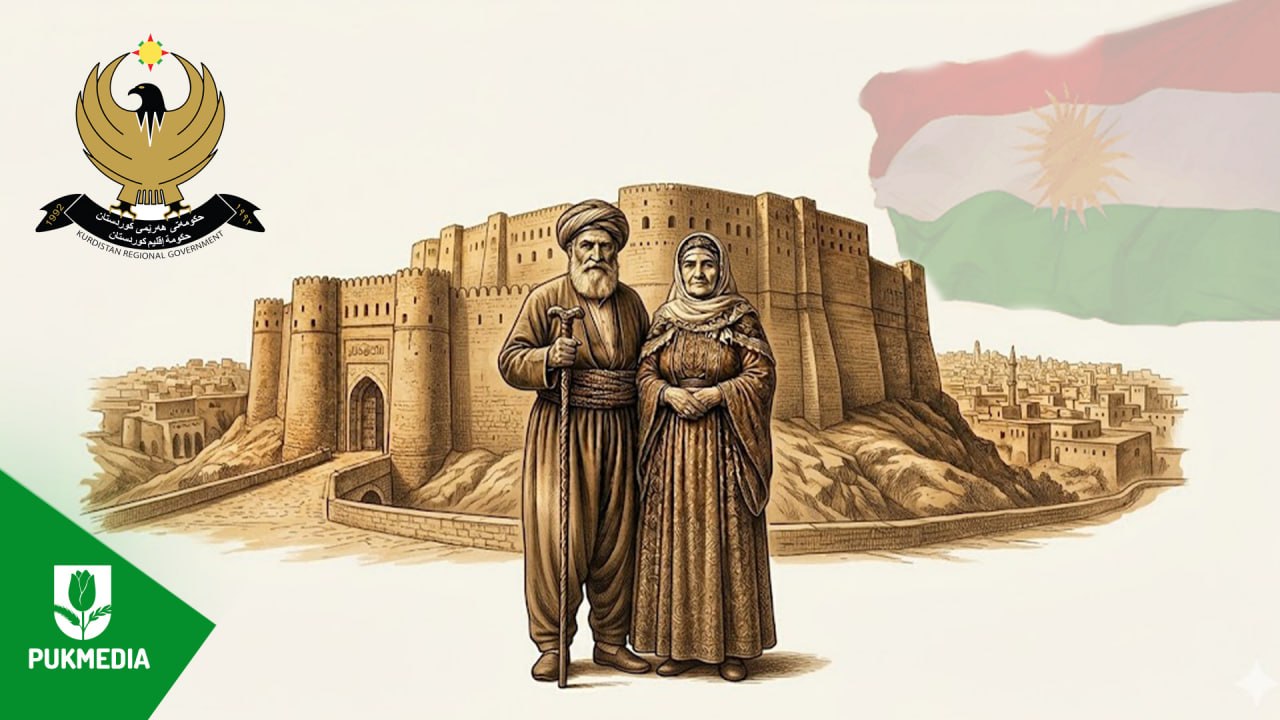 PUKMEDIA
AI generated photo of an elderly man and wife with Erbil citadel in the back ground, Kurdistan flag on the right, and KRG logo on the left.
As a result of ineffective administrative policies in the Kurdistan Region, the region is facing the prospect of a future dominated by an aging and increasingly dependent society. In this context, a member of the Kurdistan Parliament has stated that years of poor governance have had a serious impact on family livelihoods and have become a major factor behind the shrinking size of Kurdish families, a trend that could gradually push society towards aging.
The Average Kurdish Family: Between Four and Five Members
According to the latest 2024 census statistics, the average Kurdish family consists of 4.6 members, meaning most households include between four and five people. The data shows that 31.9% of the population is under the age of 15 and therefore outside the working-age category, while 68.1% falls within working age. However, this demographic balance is expected to shift in the future, with the proportion of young people of working age projected to decline significantly.
Iraqi Family Size: Between Five and Seven Members
A comparison between family sizes in the Kurdistan Region and the rest of Iraq highlights a notable difference. The average family size in Iraqi cities stands at 5.7 members, while in rural areas it reaches 6.5 members. In Saladin Governorate, the average rises to 6.7 members per family.
Within the Kurdistan Region, the average family size is 5.0 members in Erbil and 4.3 members in Sulaymaniyah. This means that, excluding parents, most families have only two or three children. This trend could transform Kurdistan from a predominantly young society into an aging one in comparison with the rest of Iraq, particularly as family sizes and the proportion of young people continue to decline.
Wrong Policies Are the Main Cause
Halmat Hoshyar, a member of the Kurdistan Parliament representing the Patriotic Union of Kurdistan (PUK) bloc, told PUKMEDIA that “the wrong policies implemented in recent years have negatively affected per capita income, which in turn has contributed to the decline in family size.”
He added that the PUK’s election slogan focused on correcting the course of governance, stressing that the party remains committed to implementing reforms that would directly improve citizens’ lives.
Fear of the Future Is Reducing Family Size
Hoshyar further explained that economic concerns are another major factor behind the shrinking size of Kurdish families.
“When instability prevails, young people postpone marriage, while others separate for various reasons,” he said. “Families are also reluctant to have more children because of financial difficulties and uncertainty about the future. This is one of the fundamental reasons behind the decline.”
PUK Government Policies Encouraged Family Growth
Hoshyar referred to the period between 2009 and 2011, when the PUK held the premiership in the Kurdistan Region, stating that Kurdish families were then more willing to have larger numbers of children.
“If we compare birth rates during that period with today, we find they were significantly higher,” he said. “This was due to the availability of marriage and housing loans, the regular payment of salaries, and employment opportunities for graduates and young people. These factors gave citizens confidence to establish and expand their families.”
He added that under current policies, many citizens are no longer considering having children because of the lack of sufficient government support.
Supporting Families Is the Solution
Regarding possible solutions to address the decline in family size, the PUK lawmaker stressed that accelerating the formation of the new government, improving living standards and providing direct support to families are essential measures to restore public confidence in the future.
He also criticised the recent reduction of child allowances in public salaries, which had not exceeded 10,000 Iraqi dinars per child.
The decline in family size is regarded as one of the leading causes behind the reduction in the youth population and the gradual emergence of an aging society. Observers warn that this trend could pose political and demographic challenges for the Kurdistan Region, particularly given the rising populations of other ethnic communities in Iraq, especially in the disputed territories.
For this reason, many believe it has become essential to reform governance and prevent citizens and public employees from becoming victims of partisan and personal interests.
PUKMEDIA
More news
-
Kazakh President Calls for Freeze of Ukraine War
10:35 PM - 2026-07-25 -
Iraq Seeks Alternative Export Routes as Strait of Hormuz Crisis Continues
07:58 PM - 2026-07-25 -
Indian Education Minister Quits Following Youth-Led Protests
05:46 PM - 2026-07-25 -
At Least 35 Killed After Two Buses Collide in Central Syria
05:00 PM - 2026-07-25
see more
.jpg)
World 10:40 PM - 2026-07-25 Iran Says Ukrainian Strike on Commercial Vessel in Caspian Sea Kills Sailor
Pire: Inclusive KRG Cannot Be Formed Without the PUK
04:52 PM - 2026-07-25
Iraqi President Urges Inclusion of Women in Top Cabinet Roles
12:36 PM - 2026-07-25
.jpg)
UN Secretary-General Arrives in Syria in First Visit Since Before Civil War
09:40 AM - 2026-07-25

U.S. President Rules Out Saudi Civil Nuclear Deal Without Israel Normalisation
09:20 AM - 2026-07-25
Most read
-
UN Secretary-General Arrives in Syria in First Visit Since Before Civil War
World 09:40 AM - 2026-07-25 -
Romanian F-16s Down Second Drone Near Ukraine Border
World 01:33 PM - 2026-07-25 -
Zelenskiy Says U.S. and Ukraine Advancing Joint Drone Production
World 10:15 AM - 2026-07-25 -
Italy's Defence Minister Offers Adviser Post to Ousted Ukrainian Counterpart
World 10:53 AM - 2026-07-25 -
Pire: Inclusive KRG Cannot Be Formed Without the PUK
P.U.K 04:52 PM - 2026-07-25 -
At Least 35 Killed After Two Buses Collide in Central Syria
World 05:00 PM - 2026-07-25 -
Iraqi President Urges Inclusion of Women in Top Cabinet Roles
Iraq 12:36 PM - 2026-07-25 -
Iraq Seeks Alternative Export Routes as Strait of Hormuz Crisis Continues
Iraq 07:58 PM - 2026-07-25
The News in your pocket
Download
 Application